


Every year, thousands of Nigerians lose their life savings to fraudulent property transactions. A seller produces convincing documents, the buyer pays in full — and months later they discover the land is under government acquisition, already sold to someone else, or the documents were completely forged.
This is not rare. It is one of the most common financial tragedies in Nigeria.
The good news is that it is entirely preventable. Knowing how to verify land documents in Nigeria before you hand over a single kobo is the single most important skill any Nigerian property buyer can have — whether you are buying land in Lagos, a duplex in Abuja, or an apartment in Port Harcourt.
This guide walks you through every document you need to check, what each one means, and exactly how to verify them — so you never become a victim.
Why Land Fraud Is So Common in Nigeria
Nigeria’s land documentation system is complex, largely manual in many states, and inconsistently enforced. This creates gaps that fraudulent sellers exploit in several ways:
- Selling land that is under government acquisition without disclosing it
- Presenting forged or photocopied title documents as originals
- Selling the same land to multiple buyers simultaneously
- Selling family land without the consent of all family members
- Using outdated survey plans that do not reflect current boundaries or ownership
Understanding the documents involved is your first and most powerful line of defence.
The Key Land Documents in Nigeria and What They Mean
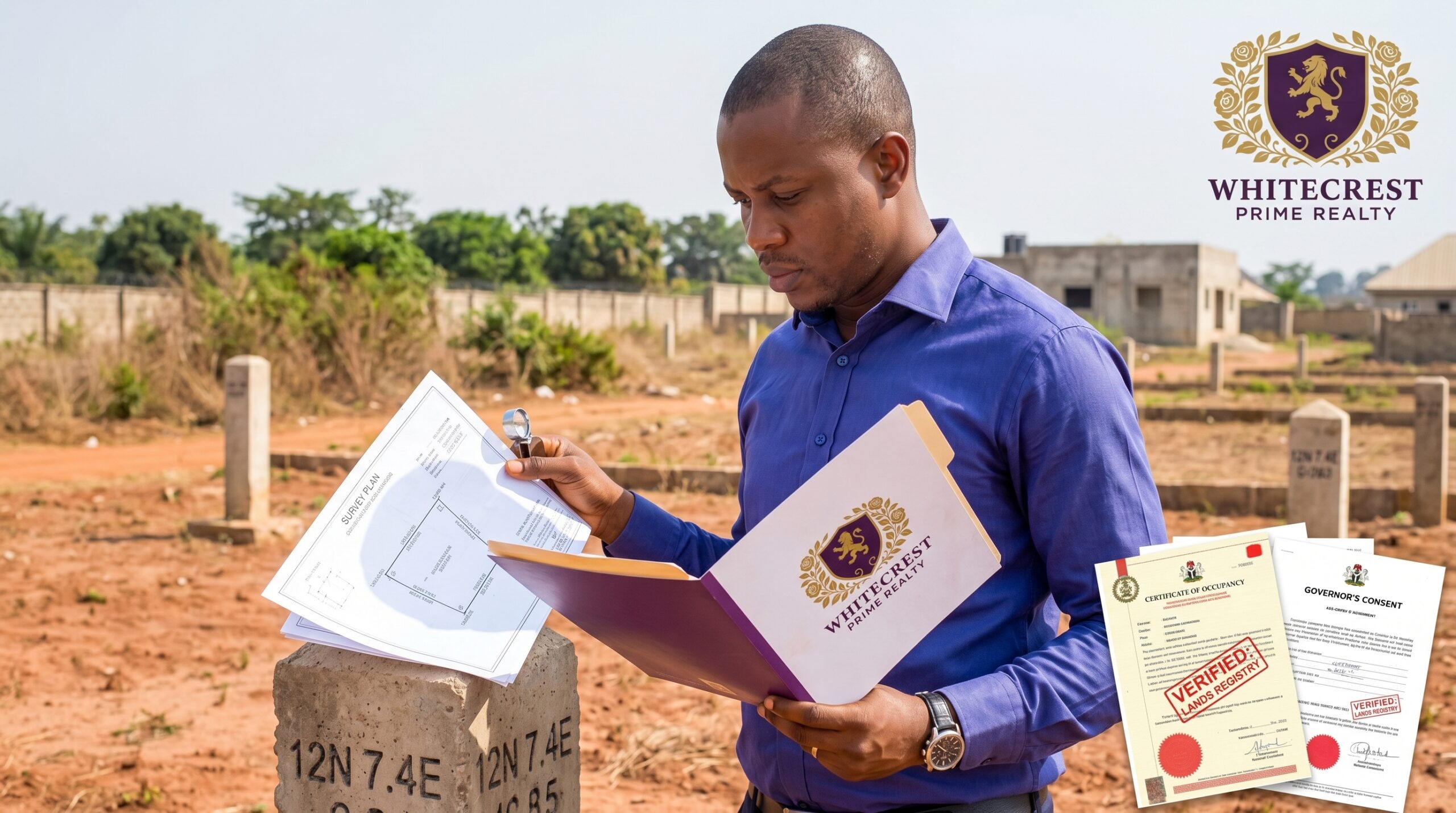
1. Certificate of Occupancy (C of O)
The Certificate of Occupancy is the most important land title document in Nigeria. It is issued by the state government and grants the holder the right to occupy and use a piece of land for a specified period — typically 99 years.
A valid C of O tells you that:
- The land has been properly surveyed and registered with the state
- The government recognises the holder as the legal occupier
- The land is not under any government acquisition or revocation
How to verify a C of O: Visit the relevant state’s Land Registry with the C of O number and request a search. In Lagos, this is done at the Lagos State Land Registry in Alausa, Ikeja. In Abuja, verification is done through the Abuja Geographic Information Systems (AGIS). Most states now also offer online search portals. A certified land lawyer can conduct this search on your behalf.
What to watch for: Confirm that the name on the C of O matches the seller’s identity. Check that the C of O has not been revoked or used as collateral for a bank loan without your knowledge.
2. Governor’s Consent
Under the Land Use Act of 1978, all land in Nigeria technically belongs to the government. When a property with a C of O is sold, the buyer must obtain Governor’s Consent to transfer the right of occupancy into their name. Without it, the transaction is not legally complete.
Many buyers make the mistake of paying for a property, moving in, and never processing the Governor’s Consent — leaving them in a legally vulnerable position.
How to verify: Check the title documents to confirm whether Governor’s Consent has been obtained for previous transactions on the property. If you are buying, ensure the process of obtaining consent is factored into your transaction timeline and budget.
3. Deed of Assignment
A Deed of Assignment is the legal document that transfers ownership of a property from the seller to the buyer. It outlines the terms of the sale, the agreed purchase price, and the rights being transferred.
This document must be:
- Signed by both the seller and the buyer
- Witnessed by at least two people
- Stamped by the Stamp Duties Office
- Registered at the Land Registry
What to watch for: Ensure the Deed of Assignment accurately describes the property using the same details as the survey plan and C of O. Any discrepancy — no matter how small — can create legal problems later.
4. Survey Plan
A survey plan is a technical document prepared by a licensed surveyor that shows the exact location, size, and boundaries of a piece of land. It contains the survey beacon numbers that identify the specific plot in the government’s records.
How to verify a survey plan: Take the survey plan to the office of the Surveyor General in the relevant state and request a search to confirm the beacon numbers are correctly registered and that the boundaries match the physical land being sold.
This step is critical because fraudulent sellers sometimes present survey plans for a completely different piece of land while showing you a different plot on the ground.
5. Gazette (for Government Allocated Land)
A gazette is a government publication that formally announces and records land allocations in certain areas, particularly in Abuja and some northern states. If a property was allocated by the government, the gazette serves as proof of that allocation.
How to verify: Cross-reference the gazette number with the relevant government allocation records. In Abuja, AGIS maintains comprehensive records of government-allocated land.
6. Excision (for Land in Villages and Peri-Urban Areas)
Excision refers to the formal process by which a portion of land is released from government acquisition and allocated back to a community or village. Land that has been excised is legally available for sale and development.
In Lagos in particular, many areas around Ibeju-Lekki, Epe, and Ikorodu involve community or family land. Before buying in these areas, confirm whether the land has been formally excised from government acquisition.
How to verify: Request a copy of the excision gazette and verify it at the Lagos State Land Registry or through a qualified land lawyer.
Step-by-Step: How to Conduct a Proper Land Search in Nigeria
Step 1 — Engage a Qualified Property Lawyer
Before doing anything else, engage a qualified property lawyer who specialises in Nigerian real estate transactions. This is not optional. Your lawyer will conduct official searches, review all documents, and flag any issues before you commit financially.
Step 2 — Request All Original Documents
Ask the seller for all original title documents — not photocopies, not scanned versions. Inspect the physical documents yourself alongside your lawyer. Check the stamps, signatures, and registration numbers.
Step 3 — Conduct an Official Land Registry Search
Your lawyer should conduct an official search at the relevant state Land Registry to confirm:
- The property is registered in the seller’s name
- There are no encumbrances, liens, or court orders on the property
- The C of O or title has not been revoked
This search typically costs between ₦10,000 and ₦50,000 depending on the state and is one of the most important steps you can take.
Step 4 — Verify the Survey Plan with the Surveyor General
Submit the survey plan to the state’s Surveyor General office to confirm the beacon numbers, boundaries, and that the land description matches the physical plot being sold.
Step 5 — Conduct a Physical Inspection of the Land
Visit the land in person. Confirm that the boundaries match the survey plan. Check for any structures, third-party occupants, or encroachments. Talk to neighbours and community members about the history and ownership of the land.
Step 6 — Confirm There Are No Government Acquisition Notices
In states like Lagos and Abuja, large tracts of land are periodically acquired by the government for infrastructure projects. Confirm with the state’s Ministry of Lands that the specific land you are buying is not under any acquisition notice.
Step 7 — Process All Post-Purchase Documents Promptly
Once the transaction is complete, process the Governor’s Consent, stamp duties, and registration of the Deed of Assignment immediately. Do not leave these steps pending — unregistered transactions leave you legally exposed.
Red Flags to Watch Out for When Buying Property in Nigeria
Not every fraudulent seller is obvious. Here are the red flags that should immediately put you on alert:
- The seller is in a hurry and pressuring you to pay quickly
- The price is significantly below the market rate for that area
- The seller refuses to provide original documents or allow a registry search
- The land has multiple people claiming ownership or right of sale
- The seller cannot show you a clear chain of title going back to the original allocation
- The documents have inconsistencies in names, dates, or property descriptions
- The seller discourages you from engaging a lawyer
If you encounter any of these signs, walk away. No piece of land is worth losing your savings over.
How Whitecrest Prime Realty Protects Your Investment
At Whitecrest Prime Realty, our Property Verification and Due Diligence service takes the burden of document verification completely off your shoulders. Our team works with qualified property lawyers and licensed surveyors to:
- Conduct full Land Registry searches on every property
- Verify all title documents for authenticity and completeness
- Confirm survey beacon numbers with the Surveyor General
- Check for government acquisition and revocation notices
- Review and prepare all transaction documents including the Deed of Assignment
We have helped hundreds of Nigerian buyers purchase property with complete confidence — knowing that every document has been thoroughly verified and every risk has been identified and addressed before they spend a kobo.
Your money is too hard-earned to risk on unverified property. Let us protect it.
Conclusion
Buying land or property in Nigeria can be one of the best financial decisions you ever make — but only if you do it right. The difference between a successful property purchase and a devastating financial loss often comes down to one thing: proper document verification.
Do not skip the legal search. Do not trust documents without verifying them. Do not be rushed into a purchase by pressure or an attractive price. And do not try to navigate Nigeria’s complex property documentation system alone.
Work with professionals who know the terrain — and protect every kobo you invest.
Ready to buy property in Nigeria with complete peace of mind? Contact Whitecrest Prime Realty today. We verify, we protect, and we deliver.
Whitecrest Prime Realty — Buy · Rent · Shortlet · Land. Across Nigeria.
📍 Lagos | Abuja | Port Harcourt | And beyond 🌐 www.whitecrestprimerealty.com 📲 DM us on Instagram: @whitecrestprimerealty



Pingback: Why Buying Land or Property in Nigeria Today Is Your Smartest Investment for the Next 10 Years. – Whitecrest Prime Realty